How large organisations build structure for images, video and documents
16 April 2026
In many organisations, large volumes of content are created every day. Images from campaigns, video from events, presentations, reports and documents are produced by different teams across the organisation.
But when content is stored across different folders, servers, email threads or cloud services, it quickly becomes difficult to stay organised. This often leads to employees spending unnecessary time searching for files, multiple versions of the same material circulating, and content being recreated even though it already exists.
Large organisations solve this by building a clear structure for how images, video and documents are managed, based on a few core principles.
1. Bring all content into one place
One of the most common challenges in larger organisations is that material is stored across many different systems. Content may exist in local folders, email threads, project tools, cloud storage and on external hard drives. When content is scattered like this, it becomes difficult to know where the correct material is.
Many organisations address this by bringing all content into a shared platform for images, video and documents. When everything is stored in one place, it becomes significantly easier to find and use.
2. Create a clear structure for content
Once content is centralised, it also needs to be organised in a way that makes it easy to navigate. Large organisations often use structures based on:
categories
projects or campaigns
business areas
metadata and tags
This type of structure makes it possible to quickly filter and find the right material, even in very large content libraries.
3. Make it easy to find the right content
When organisations manage thousands or even tens of thousands of files, folders alone are not enough. That is why many use metadata and search functionality to make content more accessible.
Material can, for example, be tagged with information such as topic or campaign, project, usage rights, as well as date or version. This allows users to quickly search for and find the right images, video or documents.
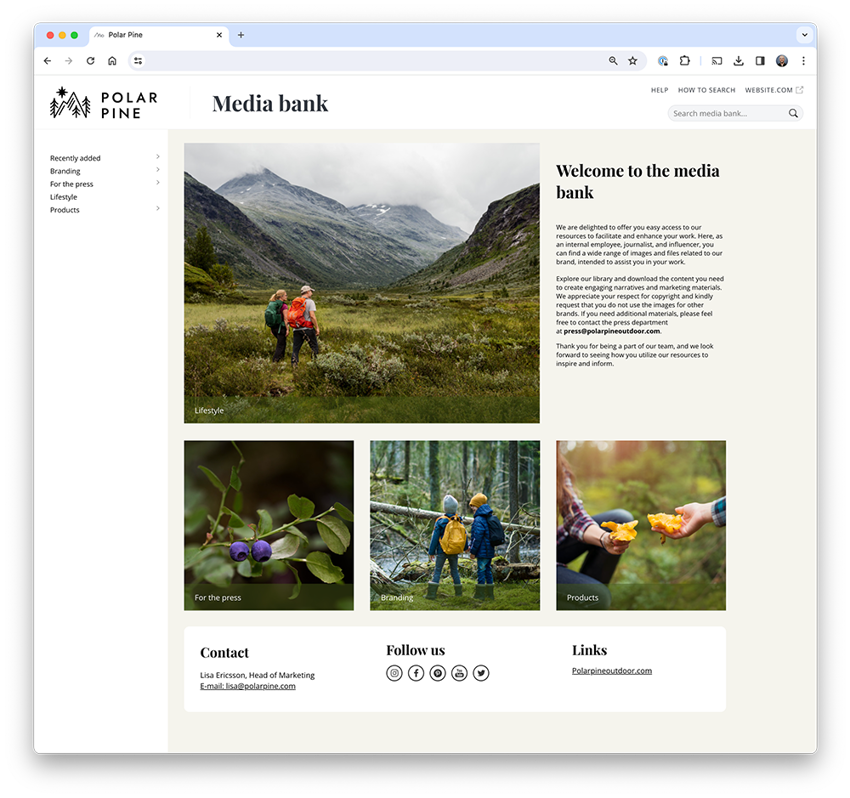
Create your own mediabank and share files internally or externally.
4. Ensure the right version is used
In many organisations, multiple versions of the same material circulate. This can lead to incorrect images being used in marketing, outdated documents being shared, and important updates being missed.
By bringing all material into a shared platform, it becomes much easier to ensure that everyone is working with the correct version of the content.
5. Make content accessible to the right people
Another key part of structure is accessibility. Many people across the organisation need to use the same material, for example in marketing, communications, HR and among external partners.
By managing access, organisations can ensure that the right people find the right material, that sensitive content is not shared incorrectly, and that external stakeholders get access to what they need.
When structure is missing, work becomes inefficient
Without a clear structure for images, video and documents, content quickly becomes difficult to manage. Employees spend more time searching for material, creating new versions and solving problems that are rooted in a lack of organisation and structure.
When organisations instead take a more systematic approach to managing content, it becomes easier to reuse material, collaborate across teams and work more efficiently in projects and campaigns.
A shared platform enables structure
For many organisations, the next step is to bring all content together in a Digital Asset Management platform (DAM).
Such a platform makes it possible to store images, video and documents in a shared library, organise material with metadata and categories, make content searchable and accessible, and ensure that the correct version is always used.
This allows organisations to build a more sustainable structure for their content, even as the volume continues to grow.
Summary
Large organisations produce large volumes of content. Without a clear structure, this material quickly becomes difficult to manage. By bringing content together, organising it consistently and making it easy to find, organisations can gain better control over their images, video and documents.
The result is a more efficient way of working and better conditions for managing content over time.
Since 2 August 2026, the EU AI Act has required that AI-generated and AI-manipulated content be clearly labelled. This applies above all to so-called deepfakes: images, audio and video created or altered with AI in a way that makes them appear authentic. It doesn't have to involve people; it could just as easily be a place, an environment or an event that looks real to the viewer.
We spoke with product manager John Robertsson about the features that have already launched and those still to come during the rest of 2026. After a run of releases early in the year, he promises the pace keeps climbing.
A common problem for many people working in Photoshop is that the creative work happens in one tool while the source files live somewhere else entirely. Mediaflow's Photoshop integration lets you bring that whole flow into a single step.